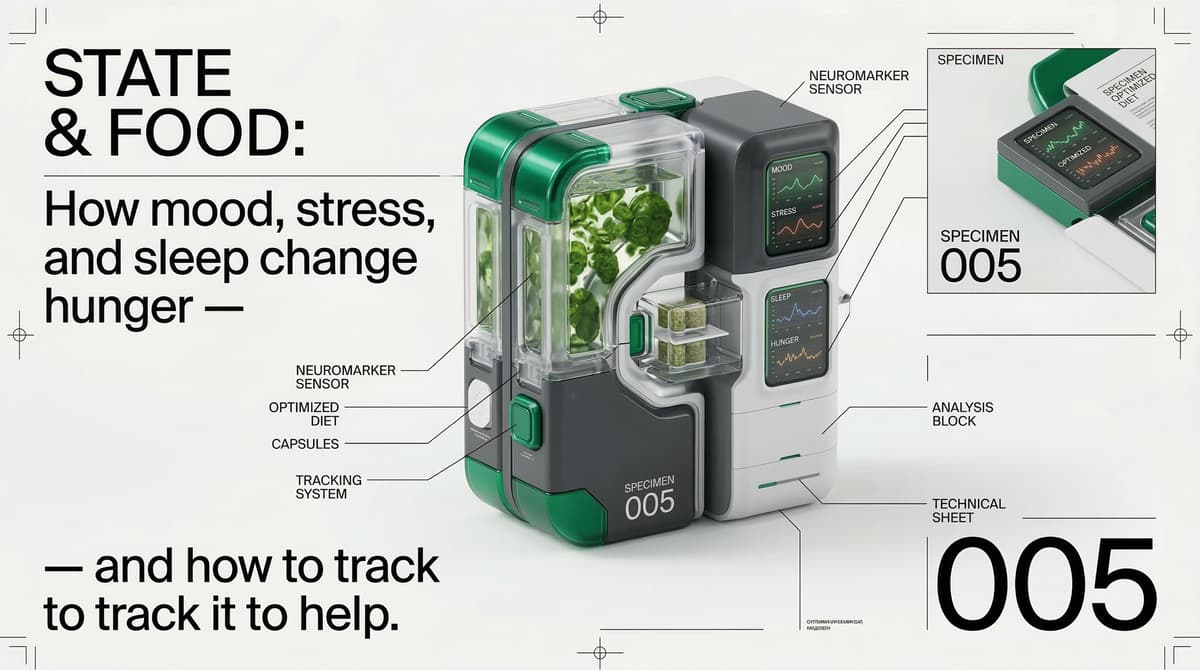
Sometimes hunger isn't about "I really need to eat," but about your state. Fatigue, anxiety, lack of sleep, work overload, or even boredom—and your hand reaches for something sweet, salty, or just to chew. This isn't a character flaw: appetite is part of the survival system, and the brain constantly checks if you're safe, calm, and energized right now.
Below is how mood, stress, and sleep affect hunger, why it happens, and how tracking your state helps you avoid self-pressure and instead support yourself.
Why "I want to eat" doesn't always mean "I need calories"
Hunger has two layers:
Physiological: the body needs energy and nutrients.
Psychological: the brain seeks a quick way to improve well-being (calm down, perk up, distract).
Food is a quick regulator. It affects dopamine and opioid systems (pleasure/reward), and can temporarily reduce tension. That's why stress often pulls toward more caloric and "comfort" foods—the brain chooses the shortest path to relief.
Sleep: the main "appetite regulator" that's easy to forget
Sleep deprivation almost always amplifies hunger. The reasons are simple and well-studied:
Hunger and satiety hormones shift: with lack of sleep, ghrelin rises ("I want to eat") and leptin drops ("I'm full"). You might crave food even on a normal diet.
Self-control worsens: the tired prefrontal cortex (the brain part that helps "choose the best") works weaker. Decisions become more impulsive.
Food seems "tastier": the brain reacts more strongly to high-calorie foods, especially sweet and fatty ones.
Key point: this isn't "you're weak," but a predictable body response. Often, the most effective "nutrition hack" isn't a new meal plan, but 1–2 nights of good sleep.
Mini-habit for the week:
pick one sleep action: e.g., fixed wake-up time, 30–60 minutes screen-free before bed, or 10 minutes morning light by the window/outside. Consistency is key.
Stress: when the body thinks you're in danger
Stress activates the "fight/flight" system. Its key hormone is cortisol. Short-term, it helps survival, but if chronic, appetite changes for many:
for some, it disappears (tension "blocks" hunger),
for others, it intensifies, especially craving fast carbs and fats,
many get "food scanning": wanting to snack more for small doses of relief.
Plus, stress worsens sleep—hitting appetite again. It creates a vicious cycle: stress → worse sleep → stronger hunger/cravings → guilt → more stress.
Mood and "emotional hunger": how to tell them apart
It's useful to learn to distinguish two sensations:
Physiological hunger usually:
builds gradually,
is okay with regular food,
decreases after a normal meal.
Emotional hunger often:
comes suddenly,
demands specific things (sweets, fast food, snacks),
persists even after eating (since the cause isn't energy).
A simple question that often helps:
"If only regular food was available now (e.g., oatmeal/eggs/soup), would I eat it?"
If the answer is "no, I want only chocolate/chips"—it's likely your state needs support.
Your cycle matters too: sometimes it's not a "binge," but a phase
If you track your menstrual cycle, it's a superpower for understanding appetite. In the second half (luteal phase), many experience:
increased appetite,
changed preferences (craving denser foods),
more water retention, weight fluctuations on the scale.
This isn't a reason to punish yourself with restrictions. It's a reason to plan: a bit more sleep, extra protein/fiber, gentler workouts, more self-compassion.
How nutrition can support your state (without fanaticism)
This isn't about perfection, but support. Three things most often noticeably affect hunger and cravings:
1) Protein + fiber in every main meal
Protein aids satiety, fiber slows digestion and stabilizes blood sugar. Result: fewer swings and sudden hunger attacks.
Combination examples:
yogurt/cottage cheese + berries + nuts/seeds,
eggs/fish/chicken/tofu + veggies + grains,
legumes (lentils/chickpeas) + veggies + olive oil.
2) Regularity (not strict regime, but predictability)
When meals are too chaotic, the brain amps up "hunger fear," strengthening cravings. Even 2–3 main meals in roughly the same windows helps.
3) Enough water and salt (especially if exercising)
Sometimes "I'm hungry" is fatigue + thirst. Post-workout, electrolytes matter too. No need to complicate: water throughout the day and normal food saltiness often fix half of "weird hunger."
Why track your state—and how to do it helpfully
Tracking's point isn't control for control's sake, but finding patterns. Then you stop thinking "something's wrong with me" and start seeing:
"Aha, when I sleep <my norm> and work without breaks, I crave sweets in the evening."
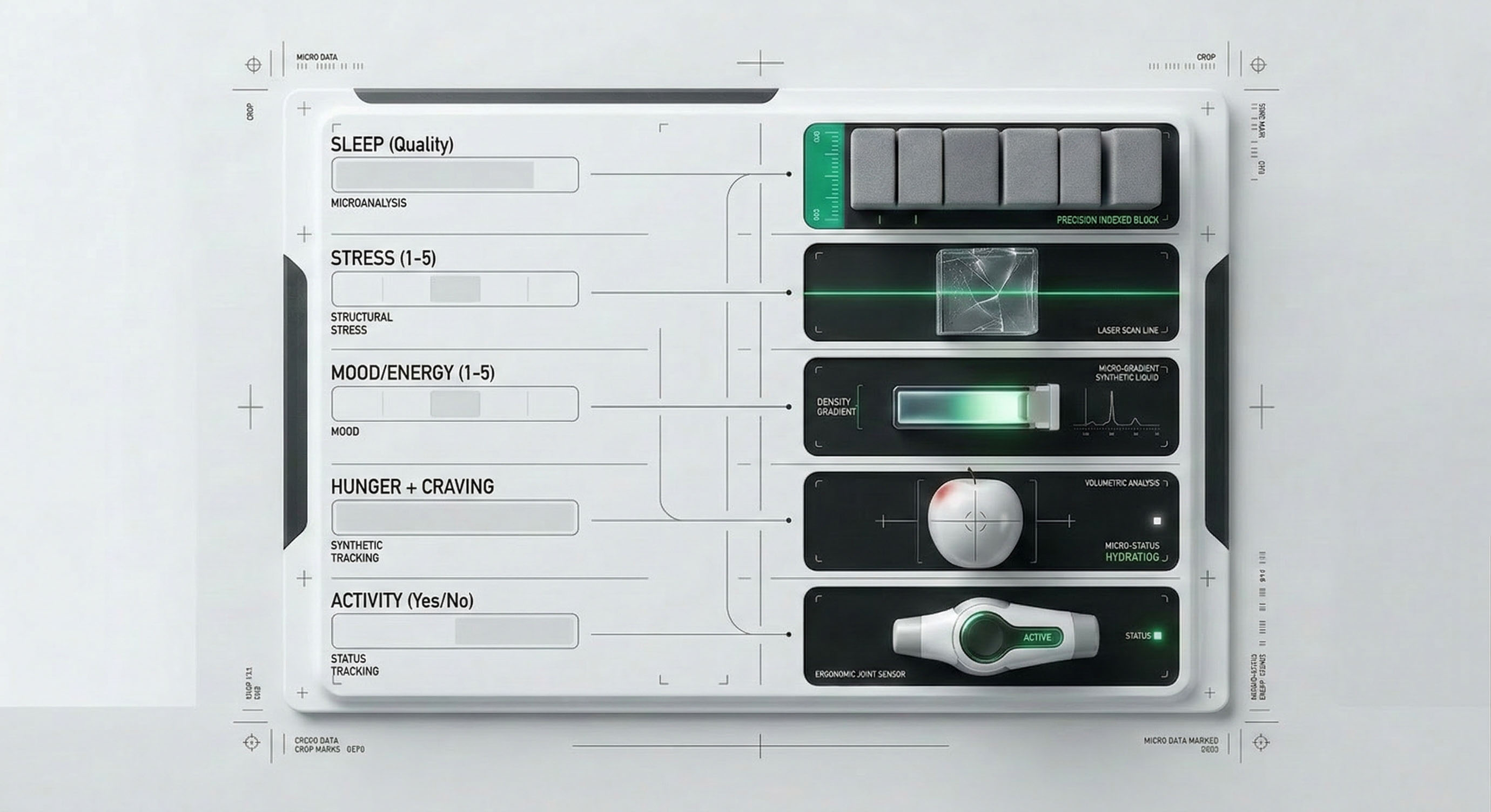
What to track (2 minutes a day)
Pick the minimum—or it'll get boring:
Sleep: amount and quality (e.g., 1–5)
Stress: 1–5
Mood/energy: 1–5
Hunger: 1–5 + "craving" (yes/no)
Workout/activity: did/didn't
Cycle: cycle day/phase (if relevant)
Nutrition: at least overall picture (or if energy allows—macros/fiber/cholesterol)
If you have food recognition by photo or dish name—that's perfect for "bad days" when no energy to count. Just log the fact, don't turn eating into an exam.
"What to do on a bad day": gentle protocol instead of willpower
A bad day isn't for heroism. It's for a gentle strategy.
Step 1. Drop the pressure to "eat perfectly"
Your goal today: satiety + stability, not a "clean eating" record.
Step 2. Build an "anti-swing" plate (simple formula)
something protein (what's actually convenient for you),
something veggie/fruit,
something carb,
a bit of fat.
This reduces the chance of cravings hitting in an hour.
Step 3. Add one small "stress exit"
Pick one:
10-minute walk,
5 minutes breathing (slow exhale),
shower,
short stretch,
text to a friend: "today's tough for me".
Overeating is often not about food, but the nervous system needing an outlet.
Step 4. If you still crave sweets—make it part of the plan
Not "I binged," but planned: e.g., dessert after a proper meal. You get pleasure without fueling swings or guilt.
Where do macros, fiber, and cholesterol fit—and why it's about state too
When tracking macros, fiber, and cholesterol, do it kindly:
Macros help spot: under-eating? short on protein? hence constant cravings?
Fiber links to stable appetite and digestion, directly affecting well-being.
Cholesterol isn't "scary," but long-term vessel care (especially if stress pushes diet to fast food and baked goods).
Main idea: numbers are hints for tuning, not judging you.
Start tracking your health and nutrition
A small takeaway that usually changes everything
If hunger ramps up with sleep deprivation, stress, or a cycle phase—it doesn't mean you're "weak." It means your body says: "it's tough right now".
The most sustainable path isn't pressuring yourself, but noticing connections: sleep ↔ stress ↔ workouts ↔ cycle ↔ food ↔ state.
Tracking that takes a couple minutes gradually becomes a map: you anticipate "risky" days and prep support (simpler food, more protein/fiber, gentle activity, early sleep). It feels like care, not control.