Lately, you often see the claim online: “Everyone needs at least 80 grams of protein a day.” It sounds simple and convenient — as if there’s one magic number that works for everyone. But nutrition doesn’t work like that: protein isn’t a “pill with instructions,” it’s part of a living system where your weight, activity level, age, goals, and health all matter.
Where “80 grams” came from — and why it’s not universal
Most of the time, “80 g” is a simplified version of recommendations that originally don’t give a fixed number, but a target in grams per kilogram of body weight.
For example, international guidelines for healthy adults often cite a “safe level” of about 0.83 g of protein per 1 kg of body weight per day — a level intended to cover the needs of most healthy people.
If you take a person who weighs 96 kg and multiply 96 × 0.83, you get about 80 g. That’s the “magic.” But if you weigh 55 kg, your “base” by the same logic is around 46 g. And if you weigh 120 kg, it’s already around 100 g. One number for everyone simply breaks the math.
And one more important point: those norms often describe the minimum for maintenance (to meet basic needs), not the “optimal” intake for sport, weight loss, or aging.
What science says — in normal human words
There are a few “layers” of needs:
Baseline for a healthy adult (maintenance): about 0.83 g/kg/day.
For active people and training: needs are usually higher; many sports recommendations converge around ~1.4–2.0 g/kg/day for most people who train regularly.
For adults 65+: it’s often recommended to go higher than the “baseline” to maintain muscle mass and function — roughly ~1.0–1.2 g/kg/day (sometimes higher with illness or very high activity).
These aren’t “orders,” they’re reference points. They help you choose a range, and then you adjust based on yourself: how you feel, how your weight/body composition changes, how training is going, and whether you have health limitations.
Who 80 g can actually fit
80 g can make perfect sense if you:
weigh roughly 75–100 kg and have moderate activity (more or less);
train regularly and keep protein closer to the athletic range;
are losing weight and want to preserve muscle better (especially if you add strength training).
But even then, it’s not only about “hitting the number” — it’s about the whole diet: total calories, fiber, vegetables, fat quality, sleep, and recovery.
Who 80 g might be too much (or simply unnecessary)
Sometimes “chasing protein” becomes extra stress and extra calories.
For example, if you:
weigh 45–60 kg, don’t train, and generally eat enough food — 80 g may be noticeably above your baseline needs;
are under-eating calories and try to “force protein” with supplements, then wonder why your digestion feels heavy;
have conditions where protein recommendations should be individualized.
How to find your protein target: a simple, non-boring algorithm
Step 1. Pick a range that matches your goal
You can use these very human-friendly targets:
Maintenance, low activity: ~0.8–1.0 g/kg
Regular training / lots of walking: ~1.2–1.6 g/kg
Muscle gain / strength 3–5× per week: ~1.6–2.2 g/kg
Age 65+ (especially if you want to keep strength): ~1.0–1.2 g/kg
If you’re pregnant or breastfeeding, needs change too: for example, EFSA indicates additional grams of protein by trimester and during lactation.
Step 2. Multiply by your weight
The formula is simple:
Protein per day (g) = body weight (kg) × chosen factor
Examples:
55 kg × 0.83 ≈ 46 g (baseline)
70 kg × 1.2 ≈ 84 g (active)
80 kg × 1.6 ≈ 128 g (training/strength)
The point is: “80 g” is just one possible result, but far from everyone’s.
Step 3. Check if it’s realistic in your life
If getting it from whole foods feels hard, don’t jump straight to the “perfect” maximum. Sometimes it’s better to:
raise protein by +10–20 g/day,
keep that for 1–2 weeks,
watch satiety, digestion, energy, weight trend, and training performance.
A key nuance: not only “how much,” but also “how you spread it”
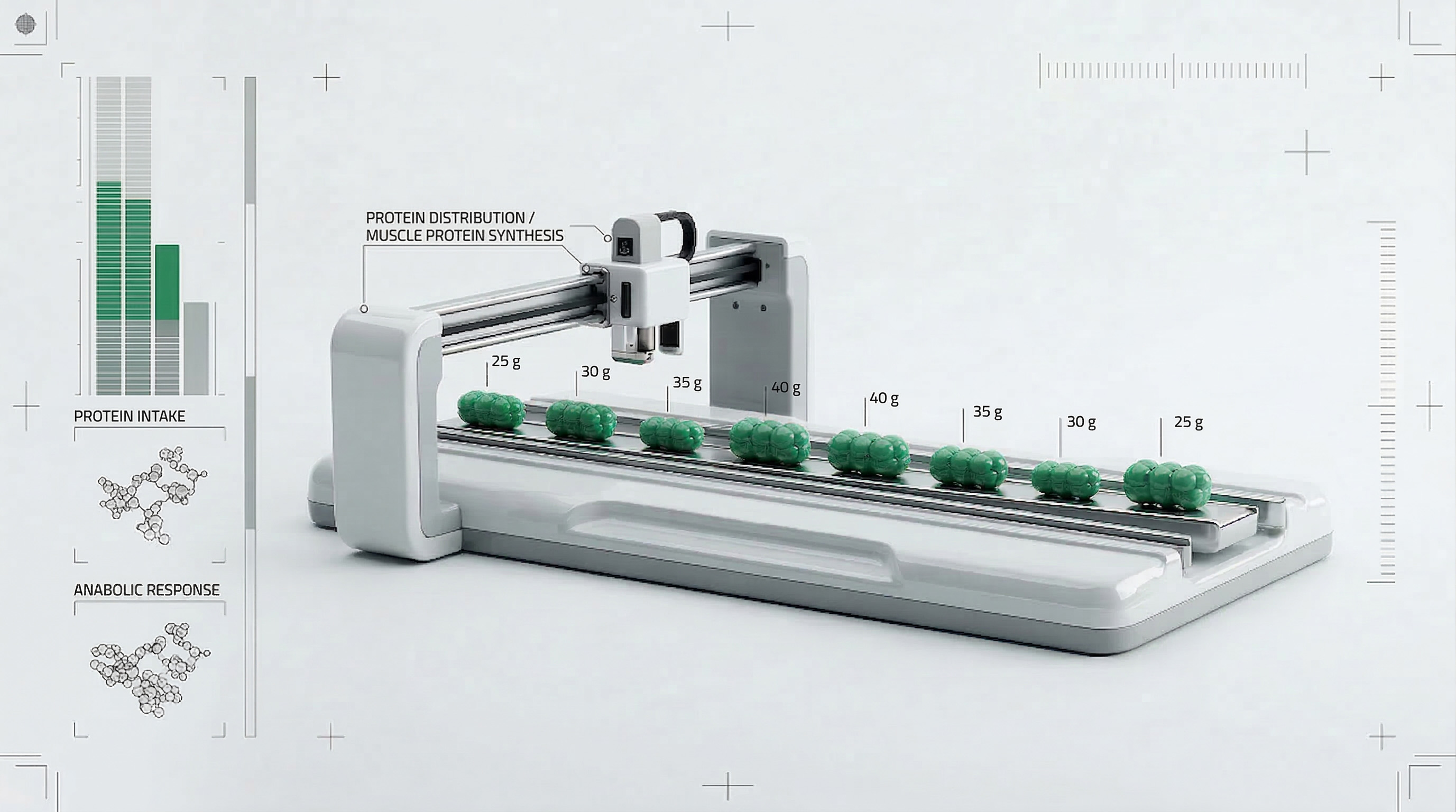
Your body often feels better when protein is distributed across the day, instead of arriving as one huge portion at night.
Research on muscle protein synthesis often gives a handy reference point: roughly 20–40 g of protein per meal (or about 0.25–0.40 g/kg per serving), repeated every 3–4 hours — this makes it easier for many people to meet needs and support recovery.
There’s also a “per-meal” approach: for example, around 0.4 g/kg per meal several times a day to maximize the anabolic response (especially relevant for training).
Protein sources: how to choose without fanaticism
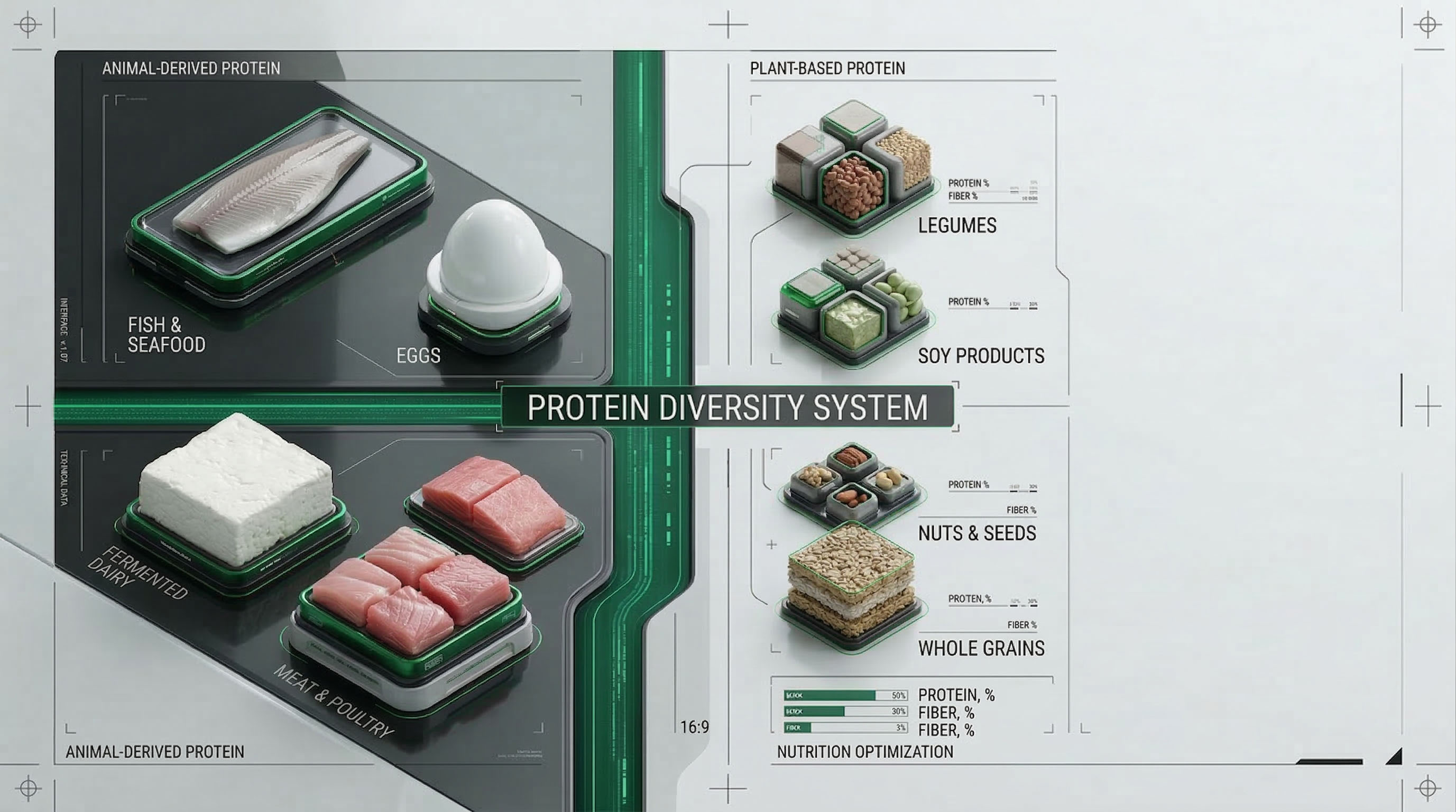
Your task isn’t to “eat only chicken breast,” but to get protein from a variety of foods so you also get vitamins, minerals, omega-3s, and fiber.
Great animal sources
fish and seafood
eggs
fermented dairy (cottage cheese, Greek yogurt)
meat and poultry (better to rotate and not rely only on red meat)
Great plant sources
legumes (lentils, chickpeas, beans)
soy foods (tofu, tempeh)
nuts and seeds
whole grains (as part of your overall protein intake)
Plant protein is totally fine. It just sometimes takes a bit more portions and variety to cover the full amino acid profile. And as a bonus, you often get more fiber.
Common mistakes that make “protein not work”
Counting protein but forgetting calories
You can hit protein and still not lose weight (if total calories are high), or do the opposite — constantly under-eat and feel exhausted.Trying to cover everything with powders
A shake is a useful tool, but it’s better when the base still comes from food — you’ll get micronutrients and real satiety more easily.Eating all protein in one meal
One huge dinner isn’t always worse than nothing — but for most people, spreading it out is easier.Ignoring health context
If you have kidney, liver, or GI conditions, pregnancy, post-surgery recovery — don’t play the “universal norm” game. Personal guidance matters more.
How Nutri can help (and make it calmer)
The hardest part about protein isn’t calculating it — it’s keeping a clear rhythm: what you eat, how much protein is there, where you’re under, and where you’re over.
In Nutri, it’s convenient to:
see protein totals by day and by meals,
compare actual intake to your target,
raise your target gradually without extremes,
track how your weight, measurements, and well-being change.
If you want, start with an honest week of observation. No perfection. No “new life on Monday.” You’ll be surprised how quickly it becomes clear.
Conclusion
80 grams of protein a day isn’t a myth in the sense of “bad,” but it is a myth in the sense of “for everyone.” A universal number is great for a headline, but your body isn’t a headline.
A much more useful idea is simple: protein is calculated from you, not from someone else’s template. Pick a range that matches your goal, multiply by your weight, distribute it through the day, eat a variety of sources — and you’ll get both results and peace of mind.